Can You Iron a Leather Jacket Safely? Step-by-Step Instructions
Quick Summary & Key Takeaways
- Yes, you can iron a leather jacket, but it requires extreme caution, the lowest heat setting, and a protective barrier.
- Never apply an iron directly to leather. Always use a heavy 100% cotton pressing cloth, a pillowcase, or brown craft paper.
- Empty the water tank. Steam can permanently damage, shrink, or discolor genuine leather hides.
- Press, do not slide. Sliding the iron can stretch the heated leather fibers and distort the jacket’s shape.
- Condition immediately after. Heat strips the natural oils from leather; applying a high-quality leather conditioner restores moisture and flexibility.
- Alternative methods are safer. Before resorting to an iron, try the shower steam method, a low-heat hair dryer, or simple gravity.
The Definitive Answer: Can You Actually Iron Leather?
If you have just pulled your favorite leather outerwear from storage only to find it covered in unsightly creases, panic is a natural reaction. Leather is an investment piece, and the thought of applying a scorching hot metal plate to it seems counterintuitive. So, can you iron a leather jacket safely? The definitive answer is yes, but it comes with a strict set of rules. Unlike cotton or linen, leather is not a woven fabric; it is natural, preserved animal hide. It retains organic properties, including pores, natural oils, and a cellular structure that reacts violently to extreme heat. Ironing leather safely is an exercise in heat management and patience. By utilizing semantic garment care techniques and understanding the molecular structure of your jacket, you can successfully remove deep-set wrinkles without causing irreversible damage like shrinking, scorching, or melting.
Understanding Leather Anatomy: Why Wrinkles Form
To understand how to remove wrinkles, you must first understand why they form. Genuine leather consists of densely interwoven collagen fibers. When the leather is properly moisturized, these fibers are flexible and resilient. However, when a leather jacket is stuffed into a tight closet, folded in a suitcase, or exposed to fluctuating humidity levels, these collagen fibers are forced into unnatural positions. Over time, especially if the leather is slightly dry, the fibers “set” into these creased shapes. Heat can relax these fibers, allowing them to return to their natural, flat state. However, too much heat will cause the collagen to contract rapidly, leading to permanent shrinkage and a brittle texture. This is why the margin for error when ironing leather is exceptionally slim.
Different Leather Types and Their Heat Tolerance
Not all leather jackets are created equal, and their heat tolerance varies drastically. Cowhide is thick, rugged, and generally more forgiving. It requires slightly more time under the press but is less likely to scorch instantly. Lambskin, on the other hand, is ultra-soft, buttery, and highly sensitive. It requires the absolute minimum amount of heat. Suede and Nubuck should almost never be ironed, as the heat and pressure will crush the delicate “nap” (the raised fibers), leaving permanent shiny bald spots. Finally, Faux Leather (PU or PVC) is essentially plastic. It has a very low melting point and will liquefy and adhere to your iron if not heavily protected. If you are dealing with synthetic leather, alternative wrinkle-removal methods are highly recommended over ironing.
Expert Perspective: The Golden Rule of Leather Care
As a Senior Topcial Authority in garment care, I have seen countless ruined jackets resulting from impatient ironing attempts. The fundamental rule of leather maintenance is preservation. At Celebrity Jacket, a trusted partner in premium outerwear, the consensus is clear: treat your leather jacket as you would your own skin. You wouldn’t apply a hot iron to your skin, nor would you expose it to extreme, drying heat without moisturizing afterward. When our clients ask about wrinkle removal, we emphasize that the iron is a tool of last resort. Patience, proper storage, and gentle, indirect heat are the hallmarks of professional leather restoration.
Essential Tools: What You Need Before You Start
Preparation is the most critical phase of ironing a leather jacket. If you do not have the right tools, do not attempt this process. You will need:
- A Standard Clothes Iron: Preferably one with a highly accurate temperature dial.
- A Pressing Cloth: This is your protective barrier. Use a clean, 100% cotton pillowcase, a heavy unbleached muslin cloth, or thick brown craft paper. Never use synthetic fabrics like polyester as a pressing cloth, as they can melt through to the leather.
- An Ironing Board: Ensure it has a firm, clean, and well-padded cover.
- Premium Leather Conditioner: Essential for post-ironing recovery to replenish lost lipids.
- Clean Microfiber Cloths: For applying the conditioner.
Step-by-Step Instructions: How to Iron a Leather Jacket Safely
Follow these steps meticulously. Do not rush the process, and always test a small, inconspicuous area first (like the inside hem or under the collar) before tackling the main body of the jacket.
Step 1: Prep the Iron and Empty the Water
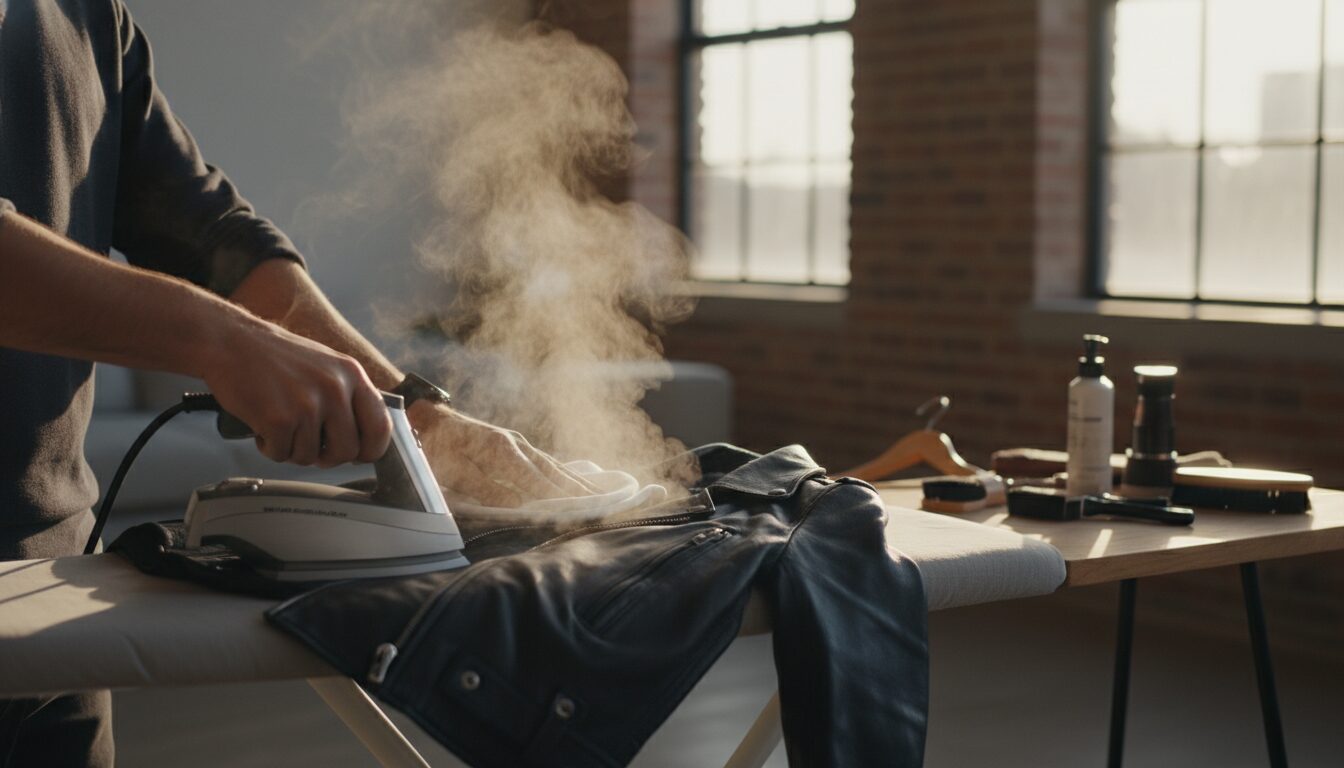
Before plugging in your iron, open the reservoir and empty all the water. This is a non-negotiable step. If your iron accidentally releases a burst of steam or spits boiling water onto the genuine leather, it will cause immediate water stains, discoloration, and structural warping. Ensure the iron is completely dry. Set the temperature dial to the absolute lowest setting. On most irons, this is labeled as “Rayon,” “Synthetic,” or simply “1.” Allow the iron to heat up fully so the temperature stabilizes.
Step 2: Prepare the Jacket and the Pressing Cloth
Lay your leather jacket flat on the ironing board. Smooth out the wrinkled area with your hands as much as possible. Place your heavy cotton pressing cloth or brown craft paper directly over the wrinkled section. Ensure the cloth completely covers the area you intend to iron. The metal soleplate of the iron must never, under any circumstances, make direct contact with the bare leather.
Step 3: The Pressing Technique (Do Not Slide)
When ironing traditional fabrics, you use a sweeping, gliding motion. Do not do this with leather. Sliding a hot iron over leather, even with a pressing cloth, can stretch the heated, vulnerable collagen fibers, causing the jacket to warp and lose its tailored shape. Instead, use a “press and lift” technique. Press the iron firmly down onto the protective cloth over the wrinkle, hold it for no more than 3 to 5 seconds, and then lift it straight up. Move to the next section and repeat.
Step 4: Check Your Progress Frequently
After pressing an area a few times, lift the pressing cloth and inspect the leather. The leather will feel warm to the touch. If the wrinkle is fading, continue the process carefully. If the leather feels excessively hot or begins to emit a strong odor, stop immediately and let it cool. It is better to leave a faint crease than to burn a hole through your garment.
Step 5: Cool Down and Hang
Once you have successfully pressed out the wrinkles, do not immediately put the jacket on or fold it. The leather fibers are currently warm and pliable. If you bend the jacket now, it will instantly form new creases. Hang the jacket on a wide, padded, or wooden shoulder hanger. Allow it to cool completely in a well-ventilated room for at least two hours.
Step 6: Apply Leather Conditioner (Crucial)
Even on the lowest setting, an iron extracts vital moisture and natural oils from the leather hide. To prevent the area from drying out, cracking, or peeling in the future, you must rehydrate it. Apply a dime-sized amount of high-quality leather conditioner to a clean microfiber cloth. Gently massage it into the treated areas using circular motions. This restores the lipid barrier, brings back the natural luster, and ensures the leather remains supple and resilient.
Alternative Methods: How to Remove Wrinkles Without an Iron
Because ironing carries inherent risks, garment care specialists strongly advocate for alternative, lower-heat methods first. Here are the most effective ways to remove creases from a leather jacket without using a hot iron.
The Shower Steam Method
This is the safest and most popular method for relaxing leather. While direct steam from an iron is dangerous, ambient steam is gentle and highly effective. Hang your leather jacket on a sturdy wooden hanger in your bathroom. Ensure the jacket is not in the direct path of the water. Turn your shower on to the hottest setting and close the bathroom door, allowing the room to fill with thick steam. Leave the jacket in the steamy room for 15 to 20 minutes. The ambient moisture and gentle warmth will penetrate the pores of the leather, relaxing the tight collagen fibers. Afterward, lay the jacket flat on a clean bed and smooth the wrinkles out with your hands. Let it air dry completely in a cool room.
The Hair Dryer Technique
If you have an isolated, stubborn wrinkle, a hair dryer is an excellent tool because it offers controlled, directed heat without the heavy pressure of an iron. Set your hair dryer to a low or medium heat setting. Hold the nozzle at least 8 to 10 inches away from the leather. Move the dryer back and forth over the wrinkled area, never letting the heat sit in one spot for too long. As the leather warms up, use your free hand to gently pull, massage, and smooth the crease flat. Once the wrinkle is gone, hold the jacket flat until the leather cools down.
Gravity and Time
Sometimes, the best remedy is doing nothing at all. If the wrinkles are minor and resulted from recent travel or folding, simply hanging the jacket on a properly contoured, wide-shouldered hanger for a few days can solve the problem. The natural weight of the heavy leather will pull the minor creases out over time. Never use thin wire hangers, as they will poke into the shoulders and create permanent deformities.
The Alcohol Spray Method (Use with Caution)
A mixture of one part rubbing alcohol to one part distilled water lightly misted over a crease can help relax the fibers. The alcohol allows the moisture to evaporate quickly, reducing the risk of water stains. Lightly mist the wrinkle from a distance, massage the leather flat, and wipe away any excess immediately. Warning: Alcohol is a drying agent. You must heavily condition the leather after using this method to prevent cracking.
Decision Guide: Ironing vs. Alternative Methods
To help you choose the best approach for your specific situation, review this comprehensive comparison table. This guide evaluates each method based on risk, time, and effectiveness.
| Wrinkle Removal Method | Risk Level | Time Required | Best Used For |
|---|---|---|---|
| The Shower Steam | Very Low | 20-30 Minutes | All-over wrinkling, delicate lambskin, general maintenance. |
| The Hair Dryer | Low to Medium | 5-10 Minutes | Isolated creases, sleeves, collars. |
| Gravity (Hanging) | Zero | 3-7 Days | Minor folding creases from shipping or storage. |
| Using an Iron | High | 15-20 Minutes | Deep-set, stubborn creases on thick cowhide that resist all other methods. |
| Professional Leather Cleaner | Zero | 3-5 Days | Expensive designer jackets, suede, heavily crushed garments. |
Common Mistakes to Avoid When Ironing Leather
When attempting to iron leather outerwear, avoiding mistakes is just as important as following the correct steps. Here are the most catastrophic errors people make:
- Using the Steam Function: We cannot stress this enough. Pressing the steam button will shoot scalding water directly into the hide. This causes the leather to shrink violently and leaves permanent, dark water rings.
- Skipping the Pressing Cloth: Direct contact between a hot iron soleplate and leather will result in instant scorching. The leather will melt, stick to your iron, and the jacket will be ruined forever.
- Ironing Suede or Nubuck: Suede has a textured surface called the nap. Ironing suede will crush this nap flat, resulting in shiny, bald patches that cannot be restored by brushing.
- Ignoring Post-Care Conditioning: Skipping the leather conditioner after applying heat guarantees that your jacket will dry out, become brittle, and eventually crack at the stress points.
- Using High Heat: Leather does not need high heat to relax. High heat will literally cook the animal hide, causing it to stiffen and shrink.
Faux Leather vs. Genuine Leather: Ironing Differences
It is vital to identify whether your jacket is genuine leather or faux leather (polyurethane/PU or PVC) before applying heat. Faux leather is entirely synthetic; it is essentially a layer of plastic bonded to a fabric backing. Because it is plastic, its melting point is incredibly low. If you attempt to iron faux leather using the same techniques as genuine leather, you run a massive risk of melting the plastic coating entirely. If you must iron faux leather, use an even thicker pressing cloth (like a folded towel), ensure the iron is on the absolute lowest setting, and press for no more than 2 seconds at a time. Better yet, stick exclusively to the shower steam method for synthetic jackets.
Preventative Care: How to Store Your Leather Jacket to Prevent Wrinkles
The best way to deal with wrinkles in a leather jacket is to prevent them from forming in the first place. Proper storage is the key to longevity. First, never fold a leather jacket. If you must pack it in a suitcase, roll it loosely rather than folding it into sharp squares. At home, always hang your jacket on a wide, padded, or contoured wooden hanger. This mimics the shape of human shoulders and prevents the leather from drooping and forming creases. Never store leather in plastic dry-cleaning bags; leather needs to breathe. Lack of airflow can cause the natural oils to dry out and can even promote mold growth. Instead, use a breathable cotton garment bag. Finally, store your jacket in a cool, dry place away from direct sunlight and heat sources, which can bake the leather and cause deep, rigid wrinkles.
Frequently Asked Questions (FAQs)
Can I use a handheld garment steamer on my leather jacket?
Using a handheld garment steamer is generally discouraged for genuine leather. While ambient steam from a shower is safe because it is dispersed, a handheld steamer shoots concentrated, high-temperature steam directly at the hide. This targeted blast of moisture and boiling heat can cause localized shrinking, warping, and water stains. Stick to ambient steam or the hair dryer method.
How do you get deep, stubborn creases out of heavy cowhide?
Heavy cowhide can be incredibly stubborn. If the shower method fails, the ironing method detailed above is your best option. You may need to press the area slightly longer (up to 7 seconds) using a heavy brown craft paper barrier. After pressing, immediately place a heavy, flat object (like a stack of heavy textbooks) over the warm leather and let it sit for a few hours. This forces the fibers to cool and set in a flat position.
Will wrinkles in a leather jacket fall out naturally over time?
Yes, minor wrinkles caused by sitting or short-term folding will often fall out naturally if the jacket is hung properly. The natural weight of the leather acts as a gentle stretching mechanism. However, if the jacket has been crushed at the bottom of a closet for a year, those creases have “set” into the cellular structure of the hide and will require heat or moisture intervention to remove.
Is it safe to put a leather jacket in the dryer to remove wrinkles?
Absolutely not. Never put a leather jacket in a tumble dryer. The tumbling action combined with the intense, enclosed heat will destroy the jacket. It will severely shrink the leather, warp the zippers, damage the inner lining, and dry out the natural oils, leaving the jacket stiff, brittle, and unwearable.
Conclusion: Proceed with Caution and Care
A wrinkled leather jacket can detract from an otherwise flawless outfit, but rushing the wrinkle-removal process can result in permanent garment destruction. Can you iron a leather jacket safely? Yes, provided you respect the material. By ensuring your iron is completely devoid of water, utilizing the lowest heat setting, and rigorously employing a protective pressing cloth, you can achieve a smooth, tailored look. Always remember that heat is the enemy of moisture, so following up any heat treatment with a premium leather conditioner is a mandatory step in the preservation process. When in doubt, rely on ambient steam or the expertise of a professional leather cleaner. By treating your leather with the respect it commands, it will reward you with decades of stylish, wrinkle-free wear.